
Signs your septic tank is full (and what happens if you wait)
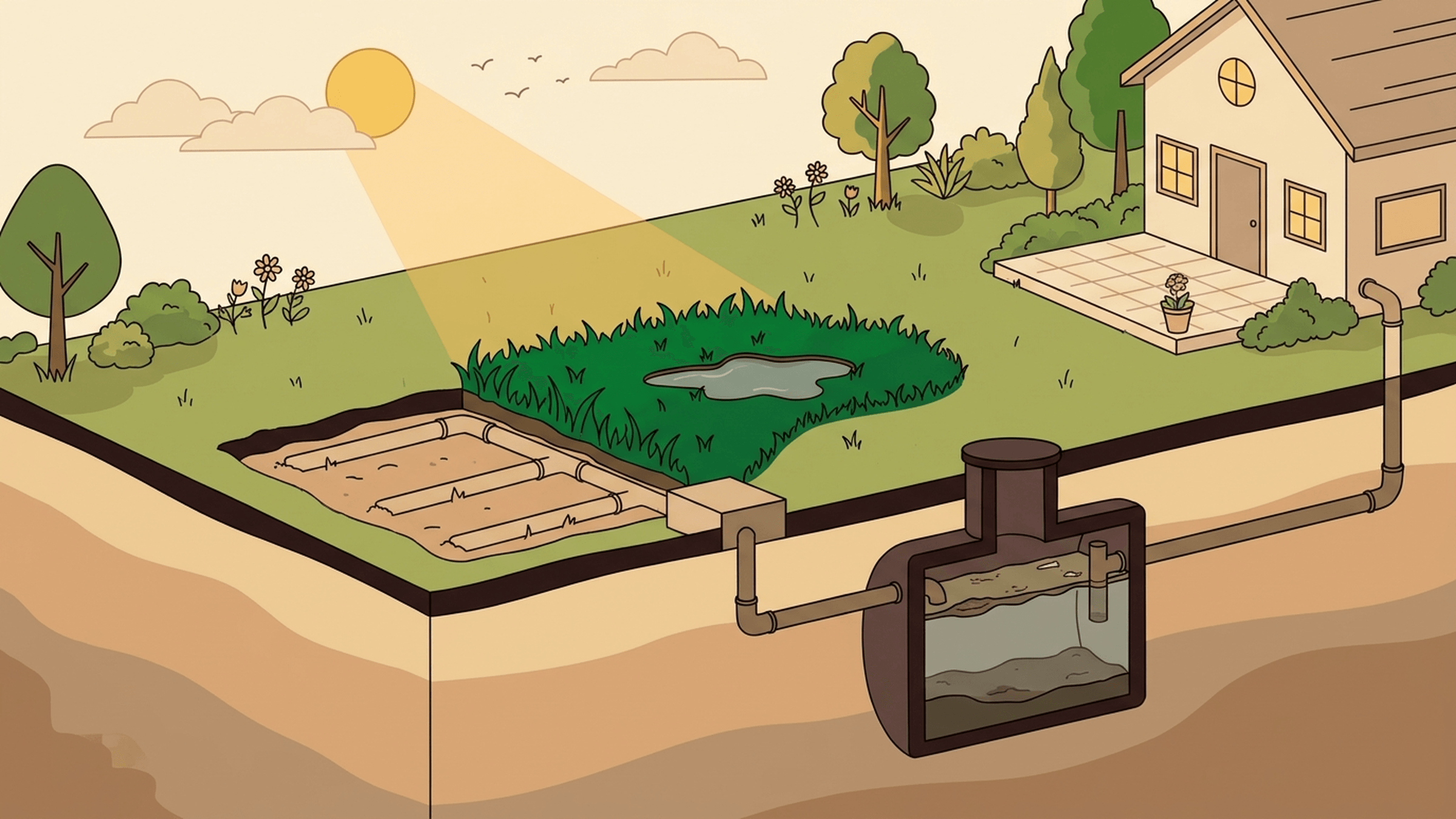
A full septic tank rarely announces itself all at once. The signs build slowly, and most of them show up in two places: the drains inside your house and the ground over your drain field.
The most common signs
The EPA lists these as signs that a septic system is in trouble. A full tank is one of the usual causes:
- Slow drains in bathtubs, showers and sinks, often all at the same time.
- Gurgling sounds in the plumbing.
- Water and sewage backing up into toilets, drains or sinks.
- Sewage odors near the tank or the drain field.
- Standing water, damp spots or soft, spongy soil over the drain field.
- Bright green, lush grass over the tank or the drain field, even in dry weather.
One slow sink on its own usually means a clog in that one pipe. Slow drains everywhere, especially with gurgling, point to the tank or the drain field.
Inside the house vs. outside
| Where you notice it | What it can mean | What to do |
|---|---|---|
| Every drain is slow and gurgles | The tank is full or the drain field is not taking water | Call a licensed septic company for an inspection |
| Sewage comes up in a floor drain, tub or toilet | A backup from the tank or the line to it | Stop using water and call now |
| Odor outside near the tank lid | A full tank, or a loose lid or riser seal | Have the tank and lid checked |
| Wet, spongy or very green ground over the drain field when it hasn’t rained | Wastewater is surfacing instead of soaking in | Call a licensed septic company and keep people and pets off the area |
If the smell is only inside and there are no other signs, our guide on septic smells in the house covers the plumbing causes that are more common.
How a pro confirms the tank is full
You can’t judge a tank by looking at the lid. During an inspection, a septic professional measures the scum layer on top and the sludge layer at the bottom. The rule of thumb in the EPA’s septic care guide is to pump when:
- the bottom of the scum layer is within 6 inches of the bottom of the outlet, or
- the top of the sludge layer is within 12 inches of the outlet.
The EPA also suggests pumping if sludge and scum together take up more than 25 percent of the liquid depth. Ask for both measurements on the service report.
What happens if you wait
A septic tank works by holding wastewater long enough for solids to settle. Oregon State University Extension explains that when sludge goes past the tank’s capacity, the wastewater no longer stays in the tank long enough to settle, and more solids escape to the drain field.
The drain field does not fail the same day. It is simply no longer protected from solids, and continued neglect can make it fail.
NC State Extension describes what follows: solids clog the pores in the soil, sewage can back up into the house or rise to the surface over the drain field, and pumping the tank after the soil is fully clogged buys only a few days. At that point the fix is often a new drain field or an advanced treatment unit, which is costly and tears up the yard. Some lots have no good place left to put a new one.
Pumping a tank on time costs a small fraction of that. Our guide on how often to pump your septic tank has intervals by tank size and household.
How long it takes a tank to fill
Oregon State University Extension says a well-designed tank has room for about three years of sludge, though some go longer.
The real number depends on tank size, the number of people and how much solid material goes in. A kitchen garbage disposal adds food solids and shortens the time between pumpings. Very roughly, from the same source:
- A 1,000-gallon tank serving two people: about 5.9 years.
- The same tank serving six people: about 1.5 years.
If you don’t know when your tank was last pumped, don’t wait for signs. Book an inspection.
What to do right now
- Cut back on water. Spread out laundry, take shorter showers and avoid running the dishwasher and washer on the same day.
- Don’t add chemical drain openers. The EPA advises against them in septic systems.
- Keep cars, people and pets off wet areas over the drain field.
- Call a licensed septic company to inspect the tank, measure the layers and pump if needed. Ask them to check the baffles and, if your tank has one, the outlet filter.
Never open a septic tank and lean in, and never climb inside one. Oregon State University Extension warns that the gases in a tank are toxic and can kill a person very quickly. Do not go in after someone who has collapsed: call 911.
After the pumping
Once the tank is pumped, ask the company whether the drain field looks healthy. If it does, go back to a normal routine: inspection at least every 3 years, pumping every 3 to 5 years or as measured, and only human waste and toilet paper down the toilet. If they find a drain field problem, our guide to drain field basics explains what it does and how to protect it.
Common questions
What happens if a septic tank is full?
Wastewater passes through the tank too fast for solids to settle, so more solids flow out to the drain field. Over time they clog the soil there. The result can be sewage backing up into the house or coming to the surface over the drain field. A clogged drain field may need to be replaced, which costs far more than pumping.
How long until a septic tank is full?
It depends on the tank size and how many people use it. Oregon State University Extension says a well-designed tank has room for about three years of sludge, and its table runs from about 1.5 years for six people on a 1,000-gallon tank to about 5.9 years for two people. The EPA's general guidance is pumping every 3 to 5 years.
What are the signs a septic tank is full inside the house?
Drains that are slow in every sink, tub and shower at once, gurgling sounds in the pipes, toilets that flush sluggishly, and in the worst case sewage backing up into the lowest drain in the house. A single slow drain is more likely a local clog in that pipe.
Can a full septic tank fix itself?
No. Bacteria break down part of the solids, but sand, grit and other material that does not decompose keeps building up. Only pumping removes it. If you see signs of a full tank, schedule an inspection and pumping.
Sources
- U.S. EPA: Frequent Questions on Septic Systems (signs of failure)
- U.S. EPA SepticSmart: How to Care for Your Septic System
- Oregon State University Extension, EC 1343: Septic tank maintenance (revised 2022)
- NC State Extension: Septic Systems and Their Maintenance
- Washington State Department of Health: Signs of septic system failure
A simple monthly routine for your tank
BT-DW is one pod a month that adds 75 billion+ Bacillus spores to your tank to help break down organic waste between pumpings. It complements routine pumping; it does not replace it.