
Septic system or sewer? How to tell
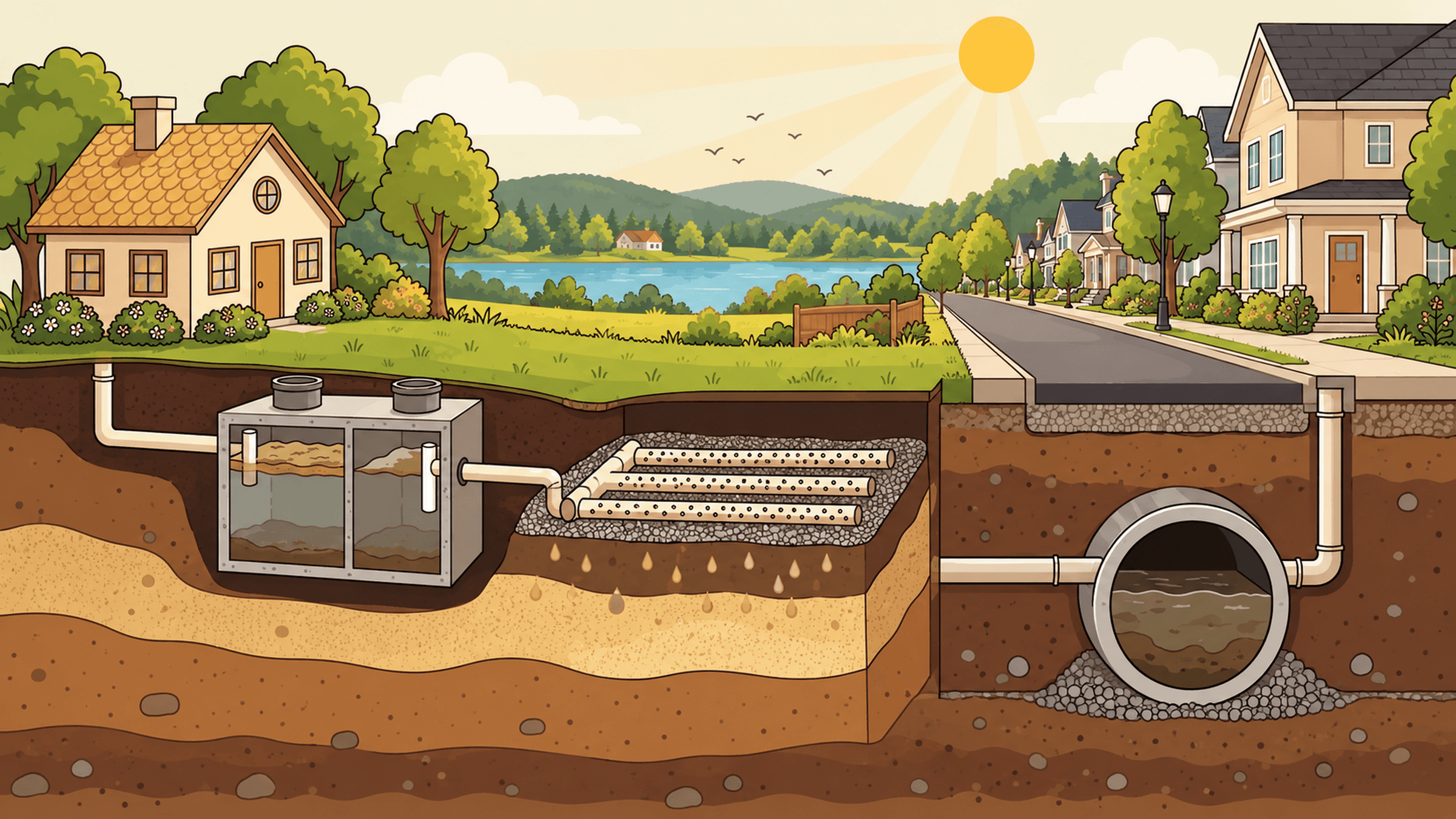
Many homeowners don’t know whether their house is on septic or sewer, especially after buying a home or moving from the city. A few quick checks usually settle it in an afternoon.
Why it matters
A sewer sends your wastewater through pipes to a treatment plant run by a city, county or private utility, and you pay for it on a bill. A septic system treats it on your own lot with a tank and a drain field, and you are responsible for its care. NC State Extension notes that septic owners should budget for inspections and pumping instead of a monthly sewer bill.
If you have septic and don’t know it, the tank can go unpumped for years. That is how a cheap pumping turns into a drain field replacement.
Check 1: your water or utility bill
This is the fastest test.
| What you see | What it usually means |
|---|---|
| A sewer or wastewater charge on the bill | You are on a public or private sewer |
| A water bill with a $0 sewer charge, or no sewer line at all | Likely a septic system |
| No water bill because the house has a private well | Likely a septic system |
The EPA’s septic FAQ lists a $0 wastewater charge, or no bill, as a sign of septic, and a private well with no water meter as another. Hawaii’s health department says it the other way around: a sewer bill or sewer charge means the property is served by a sewer. If the bill is unclear, call the utility and ask whether your address is connected.
Check 2: property records
The EPA suggests looking at your deed, building permit and house plans, which often show whether there is a septic system. Your home inspection report from the purchase may mention it too.
The best record is usually at your county or local health department, which issues septic permits. Many counties let you search online by address or parcel number. King County, Washington, for example, has site designs, inspection reports and as-built drawings that show where the tank and drain field are. Records can be missing for homes built before the early 1970s or for systems installed without a permit, so no record doesn’t prove there is no septic.
Check 3: look in the yard
If the records don’t settle it, look outside:
- Follow the main drain. Find where the main sewer pipe leaves the house (often in the basement or crawl space) and note which way it heads.
- Look for a lid or riser. The EPA says you may find a round access riser, often black or green, usually about 10 feet from the house.
- Look for a mound. Some drain fields are built into a small raised mound in the yard, according to the EPA.
- Watch the grass. A rectangle of lawn that stays greener, or a row of slightly sunken strips, can mark a drain field.
Grass and soil often cover the lid. A licensed septic company can find a buried tank with a probe or a locator.
Don’t pry open a lid you find, and never lean into or climb into a septic tank. The gases inside can kill a person very quickly. Leave opening the tank to a licensed septic company.
Check 4: ask around
- Neighbors. The EPA notes that if the houses around you have septic, yours probably does too.
- The city or county utility. They can say whether a sewer main runs on your street and whether your house is connected.
- The previous owner or the last service company. A company that pumped the tank before may have the size and location on an old service report.
If you have septic, what kind is it?
Most homes have a conventional system: a tank and a gravity drain field. Others have a mound, an aerobic treatment unit or another advanced design, as the EPA’s guide to types of septic systems describes. An air pump, an alarm panel or a control box in the yard usually means an advanced system, which needs more frequent professional service. The permit drawing tells you for sure. Our guide on how a septic system works explains the parts.
What to do once you know
If you’re on sewer, there is no tank to look after. Keep grease and wipes out of the drains and you’re set.
If you’re on septic:
- Find out when the tank was last pumped. If nobody knows, book an inspection.
- Find the tank size on the permit or a service report.
- Set a schedule. Our guide on how often to pump your septic tank has intervals by tank size and household.
- Mark the tank lid and drain field so nobody parks or builds on them.
Buying a home? Our guide to buying a house with septic covers what to ask for before closing.
Common questions
How do I know if I have a septic tank?
Start with your bill: no sewer charge, or a private well and no water bill, suggests septic. Then check the deed, building permit or house plans, look for a tank lid or riser in the yard (the EPA says the tank is usually about 10 feet from the house), and ask your county health department for a septic permit on your address.
How do I find my septic tank?
Find where the main drain pipe leaves the house and follow that line into the yard. Look for a round access riser, often black or green, or a cleanout pipe. Many county health departments have an as-built drawing that shows the tank's location. A licensed septic company can locate it with a probe or a line locator if you can't.
What septic system do I have?
The permit or as-built drawing from your county health department usually says. Clues in the yard help too: a raised mound points to a mound system, and an air pump, alarm panel or control box points to an aerobic or other advanced system. Systems with pumps and controls need an inspection about once a year, according to the EPA.
Can I switch from septic to sewer?
Only if a public sewer line runs near your property and the local utility allows the connection. Call your city or county utility to ask about the connection rules and costs.
Sources
- U.S. EPA: Frequent Questions on Septic Systems (how to find your system)
- Hawaii Department of Health, Wastewater Branch: What sort of wastewater system do I have?
- King County, Washington: Search on-site sewage system records
- U.S. EPA: Types of Septic Systems
- NC State Extension: Septic Systems and Their Maintenance
A simple monthly routine for your tank
BT-DW is one pod a month that adds 75 billion+ Bacillus spores to your tank to help break down organic waste between pumpings. It complements routine pumping; it does not replace it.