
How a septic system works, step by step
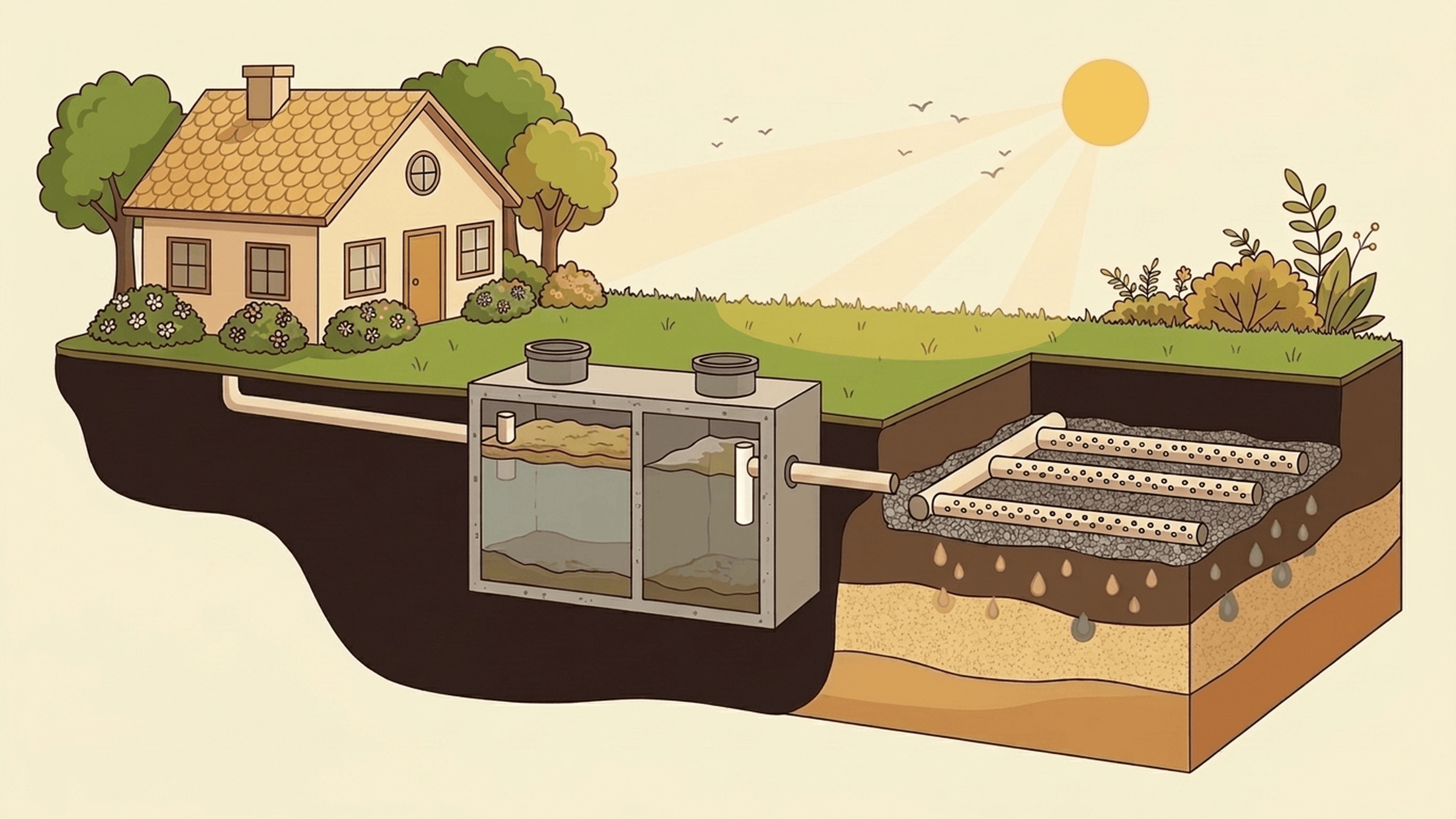
A septic system treats your household wastewater right on your property, using a tank, a drain field and the soil. Once you know the steps, it’s easier to see why pumping matters and what can go wrong.
Step 1: everything flows to one pipe
Every drain in the house (toilets, sinks, showers, the washer and the dishwasher) connects to one main drain pipe that leaves the house and slopes down to the septic tank. The EPA’s overview of how septic systems work puts it simply: all the water that runs out of your house goes into the tank. That is why what goes down the kitchen sink matters as much as what gets flushed.
Step 2: the tank separates the waste
The septic tank is a buried, watertight container, usually made of concrete, fiberglass or polyethylene. A typical household tank holds about 1,000 gallons, according to NC State Extension, with the legal size set by the number of bedrooms.
Inside, the wastewater sits long enough to separate into three layers:
| Layer | What it is | Where it goes |
|---|---|---|
| Scum (top) | Grease, oils and light solids that float | Stays in the tank until pumping |
| Liquid (middle) | Partly treated wastewater, called effluent | Flows out to the drain field |
| Sludge (bottom) | Heavier solids that settle | Stays in the tank until pumping |
Oregon State University Extension says the wastewater should stay in the tank at least 24 hours for this to happen. According to the same source, bacteria in the tank break down part of the solids, up to half of what is held there. The rest builds up and has to be pumped out.
Step 3: baffles and filters hold the solids back
A tank has a few parts whose only job is to keep sludge and scum where they belong:
- Inlet baffle. It slows the incoming water so it doesn’t stir up the sludge, as the University of Illinois Extension describes.
- Outlet baffle or tee. A T-shaped fitting at the outlet takes liquid from the middle layer and keeps scum and sludge from leaving. The EPA names it as one of the parts that keep solids out of the drain field.
- Effluent filter. Many newer tanks have a filter in the outlet. NC State Extension notes it is standard on systems installed in North Carolina since 1999 and should be checked and serviced by a professional every 2 to 3 years.
Why some tanks have two compartments
Many tanks are divided by a wall into two compartments. Most settling happens in the first one, and the second gives the liquid another chance to clear before it leaves. The EPA says compartments and the T-shaped outlet together keep sludge and scum from reaching the drain field. If your tank has two compartments, NC State Extension says both should be pumped.
Step 4: the drain field spreads the liquid
The liquid from the tank flows to the drain field, also called a leach field or soil absorption field. It is a set of perforated pipes laid in shallow trenches, often surrounded by gravel or in plastic chambers, under the lawn. The EPA describes it as a shallow, covered excavation in unsaturated soil. Water seeps out of the holes in the pipes and soaks into the ground.
Step 5: the soil finishes the treatment
This is the step most people don’t know about. Most of the actual treatment happens in the soil, not in the tank. As the water filters down, the soil removes harmful bacteria, viruses and some nutrients before the water reaches groundwater, according to the EPA. NC State Extension adds that a thin biological layer, called a biomat, forms in the soil just below the trenches and helps with treatment.
That same soil can clog. If solids escape the tank, they plug the pores in the soil, and the drain field stops taking water. Too much water at once can also flood it.
Either way, sewage can come up to the surface or back up into the house. Our guide to drain field basics covers how to protect it.
Other types of systems
Not every lot has the right soil for a conventional system. The EPA lists several types of septic systems for these cases:
- Aerobic treatment units pump air into the tank so oxygen-loving bacteria can treat the waste more fully. They suit small lots, poor soil or high water tables, and they need regular maintenance.
- Mound systems are used where the soil is shallow, the groundwater is high or bedrock is close to the surface. They use a built-up mound of sand with a drain field inside it, and a pump sends the effluent up to the mound.
- Chamber, drip and sand filter systems change how the liquid is spread or add a filtering step.
Systems with pumps, floats or other moving parts should be inspected about once a year, according to the EPA’s septic care guide. Conventional gravity systems need an inspection at least every 3 years.
What keeps it all working
- Pump the tank every 3 to 5 years, or as the measured layers say. See how often to pump your septic tank.
- Have it inspected at least every 3 years.
- Flush only human waste and toilet paper, and limit the garbage disposal.
- Spread out laundry and fix leaks so the drain field isn’t flooded.
Leave the tank itself to professionals. Gases inside a septic tank can kill a person very quickly, so never lean into an open tank or climb inside one.
Not sure whether your home even has a septic system? Our guide on septic or sewer walks through how to tell.
Common questions
Why does a septic tank have two compartments?
The second compartment gives solids another chance to settle before the liquid leaves the tank, which helps keep sludge and scum out of the drain field. NC State Extension notes that in newer tanks the outlet filter sits in the second compartment, and that both compartments should be pumped.
What does a drain field do?
It spreads the liquid from the tank into the soil through perforated pipes in shallow trenches. The soil filters it and removes bacteria, viruses and some nutrients before the water reaches groundwater. Most of the actual treatment happens there, not in the tank.
Do septic tanks need bacteria added?
The EPA says a septic tank already has enough microorganisms to work and does not recommend additives. Oregon State University Extension says additives are not needed to speed up settling or decomposition. What every tank does need is regular pumping.
How long does it take wastewater to go through the tank?
Oregon State University Extension says wastewater should stay in the tank at least 24 hours so solids can settle and scum can rise. NC State Extension describes a typical retention of about two days.
Sources
- U.S. EPA SepticSmart: How to Care for Your Septic System
- U.S. EPA: How Septic Systems Work
- U.S. EPA: Types of Septic Systems
- U.S. EPA: Frequent Questions on Septic Systems
- NC State Extension: Septic Systems and Their Maintenance
- University of Illinois Extension: How Treatment Systems Work
- Oregon State University Extension, EC 1343: Septic tank maintenance (revised 2022)
A simple monthly routine for your tank
BT-DW is one pod a month that adds 75 billion+ Bacillus spores to your tank to help break down organic waste between pumpings. It complements routine pumping; it does not replace it.