
What is a drain field, and what not to do on it
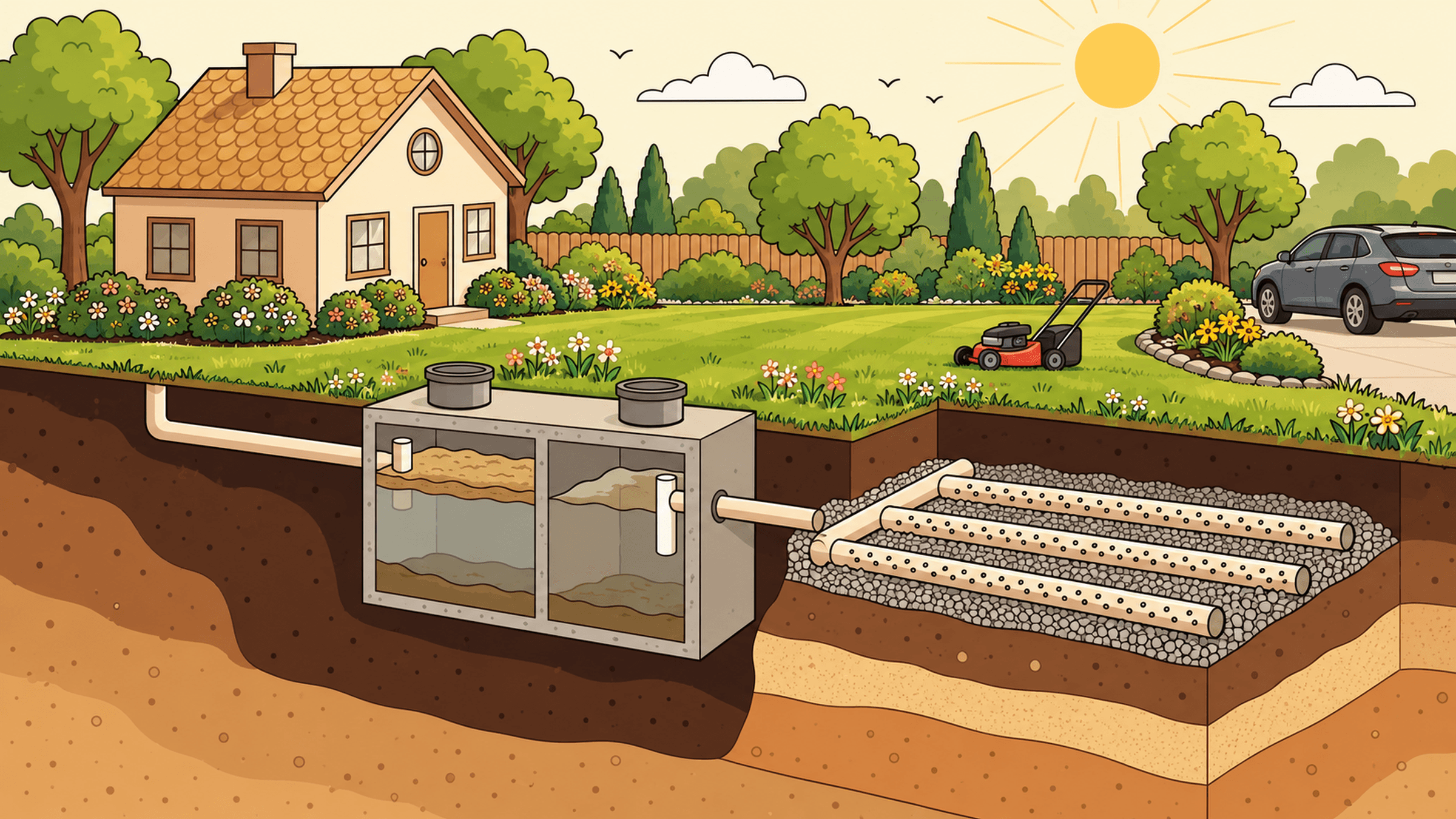
The drain field is the part of a septic system you can’t see and the one that costs the most to replace. Most of what keeps it healthy comes down to what you do, and don’t do, on the patch of lawn above it.
What a drain field is
After wastewater settles in the septic tank, the liquid in the middle flows out to the drain field. The EPA describes it as a shallow, covered excavation in unsaturated soil. In most homes that means perforated pipes laid in trenches, often in gravel or plastic chambers, under the lawn.
Water seeps out of the pipes and filters down through the soil. That soil does most of the treatment: the EPA says it removes harmful bacteria, viruses and some nutrients before the water reaches groundwater. NC State Extension notes that a thin biological layer, the biomat, forms just under the trenches and helps with that work. For the full picture, see how a septic system works.
People also call it a leach field, a leach bed, a soil absorption field or a drainfield. They all mean the same thing.
What a drain field needs
To keep treating water, the soil needs three things:
- Air. The bacteria in the soil need oxygen, so the soil can’t be compacted or sealed over.
- Not too much water. A soil that is already soaked can’t take more. The EPA warns that a flooded drain field can push sewage to the surface or back into the house.
- No solids. Sludge and scum that escape a full tank clog the pores in the soil. That is why tank pumping protects the drain field.
What not to do on a drain field
| Don’t | Why |
|---|---|
| Drive or park on it, including trucks, RVs and trailers | The weight compacts the soil and can crush pipes (EPA) |
| Pave it, or build a shed, deck, patio or pool over it | Concrete and asphalt cut off air and evaporation (EPA) |
| Plant trees or shrubs on or near it | Roots grow into the pipes (EPA) |
| Grow vegetables on it | Food may be exposed to wastewater (EPA) |
| Point downspouts, sump pumps or sprinklers at it | Extra water slows treatment (EPA). UF/IFAS suggests keeping sprinkler spray at least 10 feet away |
| Cover it with plastic, landscape fabric or thick mulch | It blocks air and evaporation (UF/IFAS, Washington State DOH) |
| Add a lot of soil or build raised beds | Extra fill changes how the field breathes and drains (UF/IFAS) |
| Let livestock graze on it | Animals compact the soil (Washington State DOH) |
The same rules apply to the reserve area, if your property has one. That is the spot set aside on the permit for a future replacement field, and Washington State’s health department advises keeping it just as protected.
What you can do on it
Grass is the best cover, according to Washington State’s health department. UF/IFAS Extension recommends shallow-rooted turfgrass and says the grass over the drain field should not be fertilized. Low flowers and ground covers work too.
Mowing is fine and is part of keeping grass healthy. Walking and light yard use are OK too. Keep play equipment light and avoid digging deeper than a few inches, since UF/IFAS notes the pipes can sit just a few inches below the surface in places.
If you are planning a pool, an addition or new landscaping, find the drain field first. Your county health department may have the system drawing on file, and a septic company can locate it.
Signs the drain field is struggling
- Soggy or spongy ground, or standing water, over the field when it hasn’t rained.
- Grass that is much greener and thicker over the field than elsewhere, in dry weather.
- Sewage odors outside.
- Slow drains and gurgling throughout the house, or backups.
Our guide on signs your septic tank is full explains how a full tank leads to these problems.
Can a treatment fix a drain field?
No. No additive, bacteria product or pod repairs a damaged drain field. Crushed pipes, roots, compacted soil, a clogged biomat or a field that sits in saturated ground need a septic professional’s diagnosis. Sometimes a soaked field can dry out and recover once the extra water is removed, as Washington State’s health department notes. Other times the field has to be repaired or replaced.
If sewage is surfacing in the yard, keep children and pets away from it, cut back on water use, and call a licensed septic company. Never open the septic tank and lean in, and never climb inside: the gases inside can kill a person very quickly.
How long a drain field lasts
A well-cared-for drain field lasts many years. The EPA’s septic FAQ says that after about 25 to 30 years the biomat can thicken enough to slow drainage, and suggests planning an upgrade before an emergency at that age. Neglect shortens that a lot.
Pumping the tank every 3 to 5 years, having it inspected at least every 3 years, and keeping water use spread out are the habits that protect the field. After a big storm, see our guide on septic systems after heavy rain.
Common questions
Can I drive or park on a leach field?
No. The EPA says most drain fields are not designed for cars or heavy equipment: the weight compacts the soil and can crush the pipes. Keep vehicles, trailers, campers and heavy machines off the drain field and the reserve area set aside for a future one.
Can I plant on a leach field?
Grass and other shallow-rooted plants, yes. Trees, shrubs and vegetable gardens, no. Roots can break into the pipes, and the EPA notes that vegetables grown there may be exposed to wastewater. UF/IFAS Extension adds that tree roots can spread two to three times the width of the canopy, so keep trees well away.
Should I mow my leach field?
Yes. Grass is the recommended cover, and keeping it mowed with a regular lawn mower is normal lawn care. What harms a drain field is weight and soil disturbance: the EPA warns that heavy equipment compacts the soil, and UF/IFAS Extension advises against tilling or digging deep there.
How long do drain fields last?
There is no fixed number. The EPA says that after 25 to 30 years the biological layer in the soil under the trenches can thicken and slow drainage, so plan for an evaluation or upgrade at that age. A drain field that gets solids from a neglected tank, or too much water, can fail much sooner.
Sources
- U.S. EPA: How Septic Systems Work
- U.S. EPA SepticSmart: How to Care for Your Septic System
- U.S. EPA: Frequent Questions on Septic Systems
- Washington State Department of Health: Caring for your septic system
- UF/IFAS Extension, SL474: Landscaping on or near septic drain fields
- NC State Extension: Septic Systems and Their Maintenance
A simple monthly routine for your tank
BT-DW is one pod a month that adds 75 billion+ Bacillus spores to your tank to help break down organic waste between pumpings. It complements routine pumping; it does not replace it.